Why a 1970s Aviation Language is the Hottest Trend in AI?
Discover how a controlled language specification from the 1970s aerospace industry is solving modern LLM hallucinations, verbosity, and agent-to-agent communication failures.
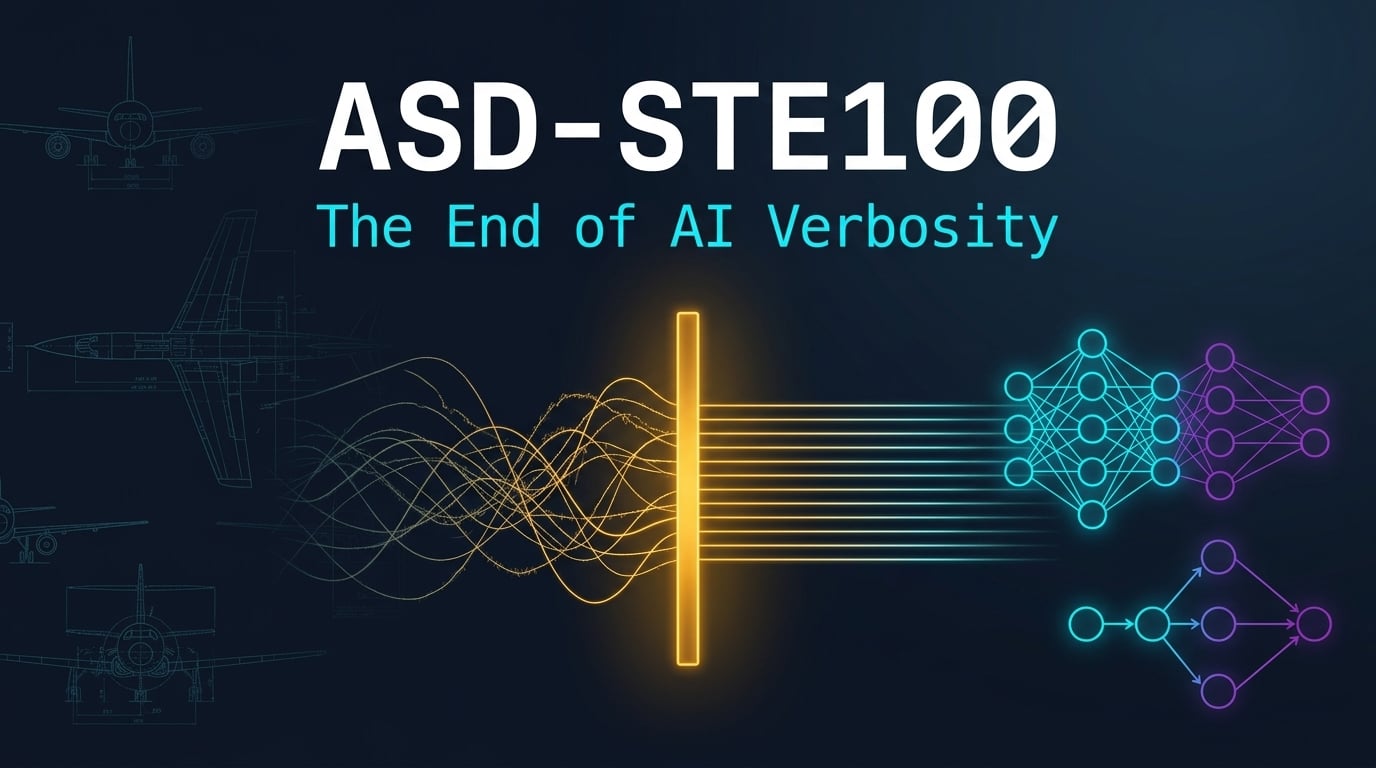
If you spend enough time in AI circles, you might have noticed a sudden obsession with an obscure acronym: ASD-STE100.
ASD-STE100 sounds like a machine part number, but it is actually a controlled language specification originally developed in the late 1970s for the aerospace industry. Suddenly, AI researchers, prompt engineers, and enterprise architects are adopting this decades-old standard to solve some of the most frustrating architectural problems with modern Large Language Models (LLMs): unpredictable output, uncontrollable verbosity, and fragile agent-to-agent communication.
To understand why a 1970s format is suddenly the hottest architectural pattern in the AI age, we have to look at the original problem it was built to solve: high-stakes ambiguity.
The High Stakes: From Aviation to Autonomous Agents
To understand STE (Simplified Technical English), you have to look at the commercial aviation industry of the 1970s. Maintenance manuals for complex aircraft were written in English, but they were executed by mechanics globally. For non-native English speakers, traditional English was a minefield. A word like check could mean to verify a state, to halt a process, or a physical piece of paper. In aviation, a misunderstood instruction doesn’t just cause a delay, it causes a catastrophic system failure.
To remove this ambiguity, the aerospace industry created a highly restricted version of English. It enforced strict rules: one word can only have one meaning, sentences must be strictly bound in length, and the passive voice is entirely banned. This was not about dumbing down the language; it was about precision engineering. This standard does not dictate document layout (like fonts or margins) but strictly controls vocabulary and grammar.
Core Structure
The ASD-STE100 specification is divided into two main parts:
The Writing Rules: Grammar and style constraints designed to remove ambiguity.
The Dictionary: A controlled list of approved and unapproved words. If a word is approved, it can only be used as its approved part of speech (e.g., “TEST” can be used as a noun, but not as a verb).
Key Writing Rules
Sentence Length: Keep instructions (procedural sentences) to a maximum of 20 words. Keep descriptive sentences to a maximum of 25 words.
Paragraph Length: A paragraph must not contain more than 6 sentences.
One Topic per Sentence: Write only one instruction per sentence. (e.g., instead of “Open the valve and drain the tank,” write “Open the valve. Drain the tank.”).
Active Voice: Always use the active voice for instructions. (e.g., “Install the filter,” not “The filter must be installed”).
Approved Vocabulary: You must only use words listed in the STE Dictionary. Words have only one approved meaning and one part of speech.
Example: Use START instead of initiate, begin, or commence.
Example: Use MAKE SURE instead of verify, ensure, or check.
No Gerunds: Avoid “-ing” verbs unless they are part of a technical name (e.g., “landing gear”).
Safety First: Warnings (risk of injury) and Cautions (risk of damage) must always come before the instruction they relate to, never after.
This brings us to modern enterprise AI. In architectural terms, AI models and autonomous agents are the ultimate non-native speakers. They do not possess human intuition, spatial awareness, or implicit contextual common sense. When we ask an LLM to orchestrate a data pipeline or, more importantly, when a routing agent communicates with a worker agent, a misunderstood semantic token can derail an entire multi-step workflow.
The Karpathy Threshold: 80% STE
This laser-focus on clarity is exactly why AI experts like Andrej Karpathy have recently become vocal advocates for its use. Karpathy popularised a prompting technique that instructs models to explain complex concepts or generate instructions using “ASD-STE100, about 80% of the way”.
Why 80%? Because enforcing 100% STE compliance requires an external validator and a highly restrictive dictionary that can break down when describing novel software abstractions. But aiming for that 80% threshold forces the model into a deterministic, highly readable state. It strips away the metaphorical fat and gives the AI a rigid, unambiguous structure that downstream agents can parse with near-perfect accuracy.
Standard English vs. ASD-STE100
To see how drastically this standard clarifies text and why it makes such a difference in system prompts, look at how typical modern coding instructions and corporate jargon are transformed under STE rules:
| Standard Tech & Corporate English | ASD-STE100 Compliant | Architectural Impact |
|---|---|---|
| Prior to pushing your commits to the main branch, ensure that all unit tests have been successfully executed and validated by the CI/CD pipeline. | Make sure that the CI/CD pipeline completes all unit tests. Push your commits to the main branch. | Replaces “ensure” and “prior to” with direct commands. Splits into two short sentences. Uses active voice. Reduces token count. |
| The developer must check the AWS server metrics and spin up additional EC2 instances if the compute capacity is found to be inadequate. | Examine the AWS server metrics. If the server load is high, start new EC2 instances. | “Check” is banned as a verb (ambiguous). Slang like “spin up” is replaced with the approved verb “start”. Clear conditional logic. |
| Due to the fact that the web traffic for https://karvics.com is currently spiking, the CDN cache should be purged immediately to mitigate latency. | CAUTION: The traffic for https://karvics.com is high. Clear the CDN cache immediately. | Warnings and cautions must always precede the instruction. Passive voice (“cache should be purged”) is removed, preventing parsing errors by autonomous agents. |
| The DevOps team must ensure that the Kubernetes cluster has sufficient resources and that the monitoring is properly configured before deploying the next release. | The DevOps team must verify the Kubernetes resources. Make sure the monitoring is correct. Deploy the release. | “Ensure” and “verify” are ambiguous. The complex sentence is broken down into simple, imperative commands that an LLM can execute without hallucinating scope. |
| It is highly recommended to circle back on the deliverables and leverage synergies before the end-of-day sync. | Review the project deliverables. Speak with the team before the daily meeting. | Eradicates ambiguous corporate jargon (“circle back”, “leverage synergies”). Replaces with concrete, approved verbs that an LLM can map to explicit actions. |
| The architecture should be designed in a way that it can be scaled to handle the increasing load. | Design the architecture so it can scale to handle more traffic. | Avoids “in a way that” and passive constructions, making the instruction clearer and more direct for an agent to parse and implement. |
Why STE Works for LLMs
From a technical perspective, why does forcing a model into a 1970s linguistic straitjacket improve performance? It comes down to how transformer architectures handle attention and probability.
1. Because, AI Agents are the New “Non-Native Speakers”
In a way, AI models and autonomous agents are the ultimate “non-native speakers”. They do not possess human intuition or contextual common sense. When we ask them to perform tasks or more importantly, when AI agents communicate with other AI agents, a misunderstood word can derail an entire workflow.
By applying STE rules to our prompts and agent instructions, we strip away the metaphorical fat. We give the AI a rigid, unambiguous structure that it can parse with near-perfect accuracy.
2. Curing the “Verbose AI” Problem (Token Optimisation)
Anyone building with recent models knows they love to over-explain. Ask a simple systems question, and you get a sprawling essay filled with caveats. STE forces constraints. By instructing models to output text in STE format, we physically restrict the token generation to the most important text only. Shorter generation means lower latency, reduced API costs, and less risk of hallucinating downstream.
3. Tightening the Attention Mechanism
LLMs use self-attention to weigh the importance of words in a sequence. When a prompt or output is filled with flowery transition phrases (“Furthermore”, “It is worth noting that”), the model’s attention is diluted across low-value tokens. STE’s strict rule of “one topic per sentence” and “maximum 20 words per procedural sentence” means the attention heads remain highly concentrated on the operative verbs and target nouns.
4. Killing the “AI Smell”
STE solves the subjective but highly annoying side effect of modern LLMs: the “AI smell.” The sudden appearance of words like “delve,” “testament,” and “multifaceted” is a byproduct of the model’s probabilistic training weights favoring certain eloquent-sounding structures. Because STE relies on a strict, approved dictionary of plain words and bans complex grammatical gymnastics, it mathematically prevents the AI from generating that typical robotic fluff.
The Architect’s Bottom Line
When you look at enterprise AI architecture, it becomes obvious that engineering the integration layers is only half the battle; we must also engineer the language layer. A raw model is a powerful reasoning engine, but left to its own devices, it is overly chatty and prone to semantic drift.
ASD-STE100 acts as an indispensable operational layer for your prompts and agent outputs. It transforms fragmented, ambiguous language into stateful, secure, and resilient instructions. It dictates whether an agent-to-agent communication handoff is a risky roll of the dice or a governed, scalable protocol. Ultimately, while the foundational model determines the ceiling of how intelligent your system can be, structural constraints like STE define the floor of how reliable it actually is in production.
About the author
- I have spent over a decade architecting systems, which has taught me that the interesting problems are rarely the technical ones - they are the trade-offs, the governance questions, and the "why did we actually build it this way" conversations. I write about enterprise architecture, AI adoption in regulated industries, and the occasional opinion on developer tooling.
Comments
Join the discussionNo comments yet. Be the first to comment.